
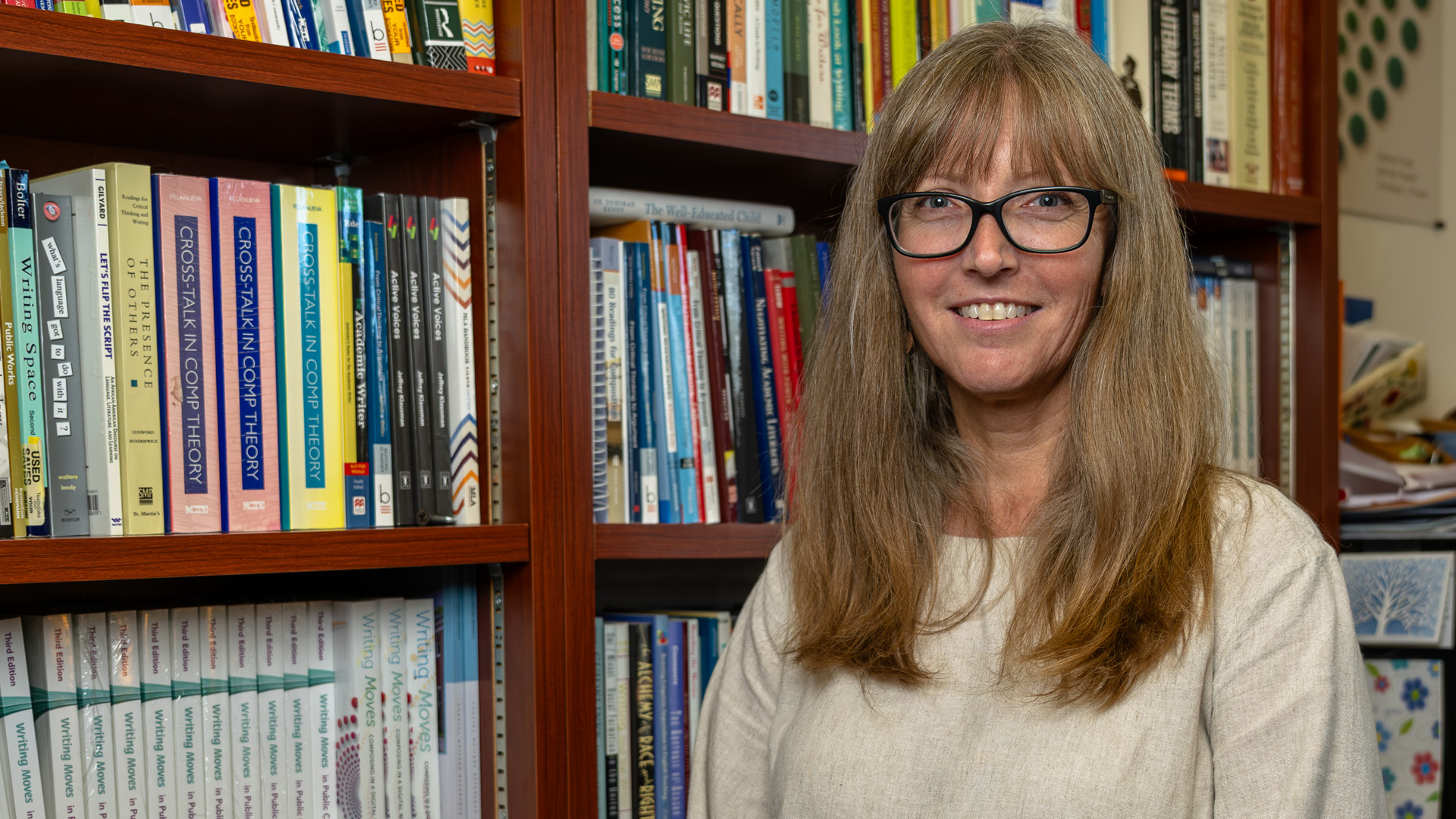
Denise Paster relied on guidance and mentorship in the early stages of her career; now she’s a mentor for university students of her own
By Kaila Balazs
Photos by Lily Whitener
When she entered college, Denise Paster had no idea she was interested in teaching — let alone that she would one day be the associate chair of an English department.
Paster, professor in CCU’s Department of English, originally majored in geology, until she realized she was more interested in the field of composition and went on to discover a love of teaching. What began as an academic awakening blossomed into a passion for the field. Today, Paster helps students with their own academic journeys and provides them with an outlet for their graduate successes.
Paster grew up an hour away from Bridgewater State College, located in Massachusetts, where she enrolled in 1995. Only the second in her family to pursue a college degree, Paster pushed her parents to allow the opportunity to attend and live on a campus close to home.
At the time, Paster was pursuing a degree in geology because her father had encouraged her to become a scientist. However, in a class where she was dating rocks, nothing made sense to her at all. Paster found herself lost as her fellow peers were asking questions she didn’t understand.
“I was going to every class. I was doing all my homework, and it just didn’t click,” Paster said.
It wasn’t until Paster had a paper to write that she found interest in the course for the first time. Paster’s geology professor noticed this change and encouraged Paster to pursue English in place of geology.
Paster had already been working at the writing center as a tutor, where she was learning about the field from the director of the writing center. As Paster moved through the English program, she discovered Anne Doyle, a recently hired professor who specialized in composition. Taking courses from Doyle became Paster’s introduction to the field.
“By the time I graduated from Bridgewater, I knew composition was the field I wanted to go into,” Paster said.
From there, Paster was encouraged by Elaine Hays, writing center director, to apply for a master’s program at the University of Massachusetts Boston — this time, with teaching in mind.
“I was really excited because she talked a lot about the program,” Paster says. “All sorts of things they were doing there, and it was really exciting to me.”
The master’s program was the start of Paster’s journey into the field of composition and pedagogy. Paster found herself working closely with mentor Eleanor Kutz, with whom she co-taught and published textbooks. Paster was beginning to get a feel for the field and branch out into new experiences with her peers.
“In academia, your graduate program often becomes like your academic family,” Paster said.
Paster speaks highly of mentors who helped her along the way, and she reminisces about every person with whom she’s crossed paths. Paster hadn’t considered that she would one day do the same for students of her own.
Bryn Hoffer, a junior majoring in English education, took Paster’s English 300 course in Spring 2026. She had begun as an English major interested in pursuing editing as a career. After Paster’s class, Hoffer realized she had other options.
“[Paster] taught me a lot about the field of English,” Hoffer says. “It was very enlightening because we got to have professors from all different fields come in.”
Hoffer decided to change her major from English to education after taking Paster’s course. Now, Hoffer feels more confident about the career she wishes to pursue. As her geology professor had done for her, Paster encouraged Bryn to switch majors to a field that was more fitting for her.
Critical Conversations, Paster’s English 300 course, helps students just starting out in their degrees explore options they have in the field. By diving into each part that makes the field whole, students can explore which areas are most appealing to them and what they would be interested in pursuing as they continue in their academic career.
Emma Howes, associate professor and former coordinator of English, works alongside Paster in the composition program. The two went through the same Ph.D. program and have been working together ever since. Now both involved in teaching undergraduate and graduate level courses, the two also make time to collaborate and publish academic articles.
“[Paster] is one of the most efficient people that I know,” Howes says. “She’s really good at getting things done in a way that always kind of amazes me.” As Paster enters her fifth year in the associate chair position, she continues to provide students with helpful tools to grow in their academic endeavors, teaching them how to prepare for the future, as well as taking the time to enjoy the journey in the process. Her continued dedication to the field shines through to her work, whether she’s in the classroom or working on her next publication
Leave a Reply