
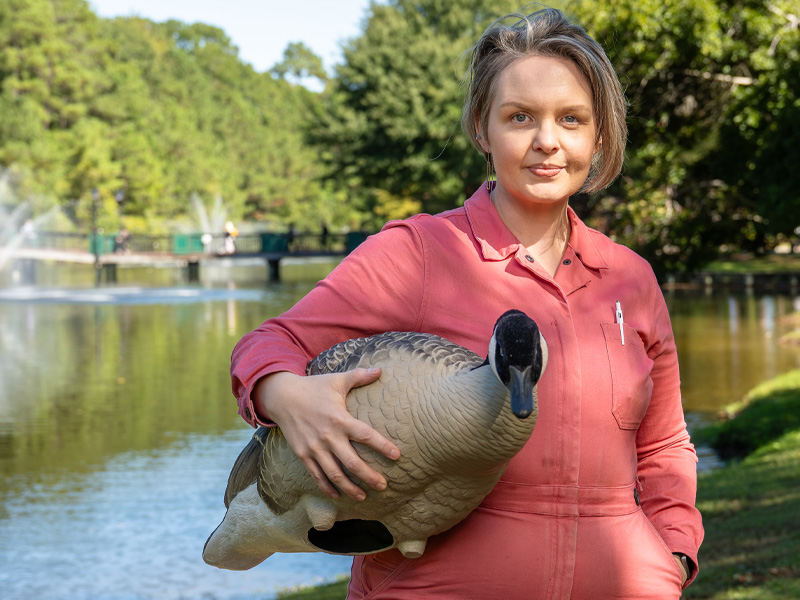
Emotional vulnerability and the social role of art shapes Sandrine Schaefer’s classroom
By Jayden Ockert
Photos by Lily Whitener
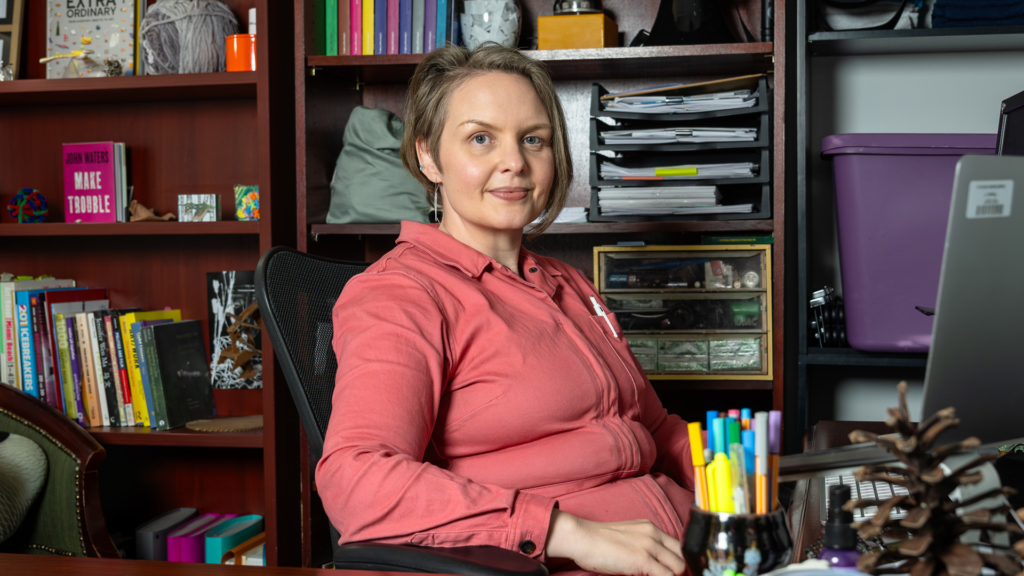
With framed gouache paintings, a photograph of a sunburnt back, and a cartoonish breakfast painted on a kitchen chair, the office space of Sandrine Schaefer, associate professor in the Department of Visual Arts, makes your eyes widen and your mind wander. Three years ago, I felt that wonderment upon walking into my first art studio class, a space that was home to cardboard, plaster, and creativity.
While most people think of paintings and sculptures as visual art, Schaefer’s work employs mediums not found at the craft store. Schaefer creates art across physical and spatial mediums, such as interactive performance art. Their work includes acts displayed in public spaces that create a unique sense of placement. For example, in their series titled “Sun Rituals | Being (small),” Schaefer traveled throughout Mexico sunburning images onto their back and photographing themselves in culturally significant landscapes. “The material is the body, shared time, and the audience,” Schaefer said. “In a performance art piece, you as the witness are just as important as I am if I’m performing.”
Being a performance artist has taught Schaefer about the emotional vulnerability that art demands from its creator and audience. In 2026, when students are required to reenvision the world amidst paradigm shifts, Schaefer’s teaching and artwork are proof that imagination can be a means of understanding ourselves, each other, and the beauty of vulnerability.
Schaefer’s lessons on creativity start in the studio, where they encourage their students to use art as a channel to view themselves and the world through a sensitive, emotionally attuned lens.
When I was in their class and Schaefer assigned me to create a “wearable” art piece that held personal meaning, I was lost. After they encouraged me to reflect on a feeling deep within, I decided to confront my fear of snakes by constructing a cardboard boa constrictor with papier-mâché scales to hang around my neck. Not only did Schaefer inspire me to create new art, but they also emboldened me to express myself in new, vulnerable ways.
Schaefer’s lessons have shaped how alumnus Francis Ludwig ‘25 views her surroundings. Looking back, Ludwig recalls Schaefer’s teaching style from the performance art class Ludwig took years prior: “We would do these exercises about noticing things and being aware of what’s around you and seeing everything as art,” Ludwig said. Even now, Ludwig’s gaze lingers over everyday sights, seeing something deeper. “The other day…I really liked the way that the light was moving on the escalator,” she said. “Whenever I notice things like that, I just think ‘God, I wish I could talk to Sandrine about this because they would understand why I’m so excited.’”
Critique is one of the most vulnerable aspects of the artistic process, and it can be particularly difficult for student creators because it feels intensely personal and exposing. To make their students feel more comfortable, Schaefer handles every classroom feedback session with care.
“Instead of trying to suppress [vulnerability],” Schaefer said, “I went in the opposite direction.” Schaefer’s classroom critiques may begin with deep breaths, unfold at a relaxed pace, and involve dispersing the students into small groups. These small adjustments allow students to express themselves and feel comfortable being vulnerable.
With so many lessons to teach about the way we understand ourselves and each other, Schaefer is a linchpin in the Edwards College. In Spring 2026, they worked alongside a small group of students with the Center for Collaborative Research (now the Edwards Research Institute) to create a workbook on how to exchange and receive feedback. As I leaf through “The Critique Respiratory Volume 1,” it is unlike any publication I’ve seen before: the entire book can be printed off a desktop, folded like a zine, and drawn in like a coloring page.
Yvette Arendt, associate professor of visual arts in painting/drawing, values the contributions Schaefer has made to the Coastal arts community.
“As educators, we’re taught how to be really good in our discipline, but not necessarily always how to teach it.” Arendt said. “Critiques are something that we kind of learn on the job, and to have an understanding more of the psychology behind it is great.” Schaefer’s workbook serves as a resource for faculty and students when navigating emotional vulnerability.
At a time when humans are forced to reimagine the world to sustain the future, Shaefer’s lessons about art and empathy resonate beyond the classroom.
“[Art] offers this kind of second space outside of reality, and that offers the opportunity to imagine in ways that are really important for society,” Schaefer said. “Human beings are beautifully sensitive, whether we want to admit it or not. Art also can heal in that way.”
Leave a Reply