
By Nora Smith
A singular bookshelf rests against the wall, each of its books a thought-out pathway for students, mapped out by their professor.
Joseph Fitsanakis, a professor of intelligence and security studies, sits in his office, reflecting on his lifelong love for literature.
“I’ve loved books, always, and I’ve always loved the experience of reading books,” said Fitsanakis.
This passion for literature is now a way for Fitsanakis to foster personal connections with students by catering to them as individuals and granting them books about their specific area of interest in the field of intelligence and security. These books passing from professor to student have a lasting impact on these students’ personal and professional lives.
Fitsanakis explained that his collection of books is like a carpenter’s shed of tools. As a professor, Fitsanakis even compares himself to the 21st century version of a monk, one who shuts himself in a room and reads manuscripts repeatedly, in hopes of learning more.
“We’re creating from scratch because there was no such thing as intelligence studies before 9/11,” says Fitsanakis, admiring his bookcase while explaining how professionals in this field must read up on everything published in order to understand and progress, since it is a newer field.
Savannah Bennett, a senior intelligence and security studies major, didn’t think much of it when Fitsanakis told her she has to read in this profession. She even assumed he was like every other professor, having her do these readings she wasn’t necessarily interested in.
Yet, soon enough, Bennett found herself reading a strangely familiar story.
Originally, Bennett had doubts about going into the intel field while being in a sorority. She explains that there’s a stereotype toward girls in sororities as just being a “sorority girl” and nothing more in addition to other biases that undermine their intellectual capabilities.
Feeling doubtful, Bennett kept asking herself, “Do people even take me seriously?”
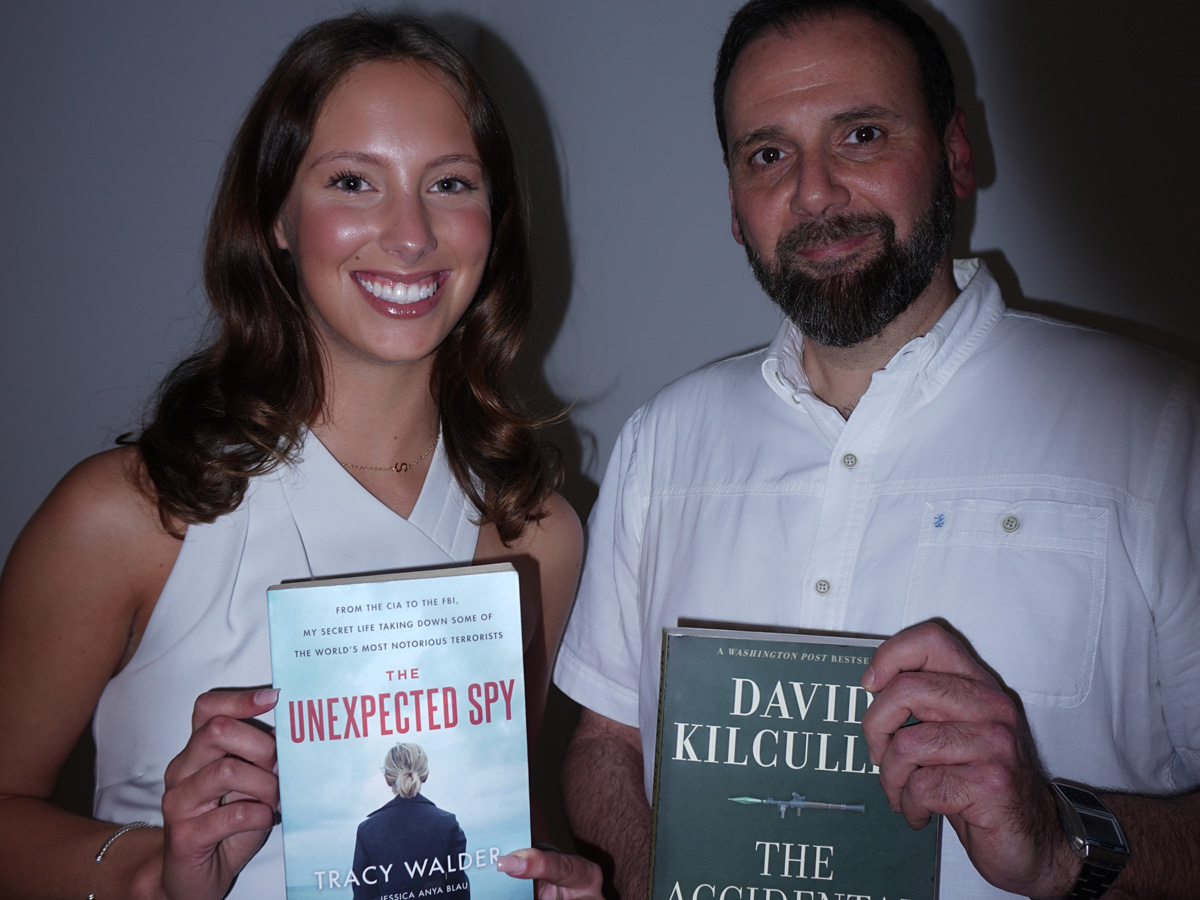
Bennett’s question was indirectly answered after she read The Unexpected Spy, a book Fitsanakis had given her about a sorority girl who ended up working for the CIA. A book awfully close to Bennett’s own situation.
“The first book he ever gave me was to inspire me,” said Bennett. Fitsanakis later gifted her The Accidental Guerrilla: Fighting Small Wars in the Midst of a Big One to keep, with a note inside reading, “This will change how you see everything.”
It has. And it inspired even more conversation between Bennett and Fitsanakis.
“He was learning more about me in the process, and then eventually he would tell me about himself in the process,” said Bennett. “A connection was building, and we didn’t see it happening because it felt natural.”
Bennett isn’t the only student who connects with Fitsanakis with through books.
“[Fitsanakis] always says to all of his students, ‘If you ever find something you really want to read, let me know and I’ll get it for you. I’ll find some type of access for you,’” said Bennett.
These books are vessels of knowledge that Fitsanakis grants his students to inspire, mentor and heighten their interest in the field. Fitsanakis gets to know his students and then carefully selects books tailored to his student’s interests, helping them visualize their potential and enjoy the learning process.
Bennett said Fitsanakis gives books to other students as well.
“It’s really just catered to how you think and what you’re interested in,” said Bennett.
Lora Pitman, assistant professor of intelligence and security studies and Fitsanakis’ next-door office neighbor, considers him an undeniable inspiration.
“Anything that I ever needed, anything that students ever needed, he was there,” said Pitman. “He’s just really this amazing individual, this amazing professor, this amazing colleague, this amazing mentor.”
Pitman recalls a time when Fitsanakis was on sabbatical yet still took time to do things for students just the same, or how he always stops whatever he’s doing to write a letter of recommendation.
Bookshelves are not only a home for vessels of knowledge, but also a place for meaningful gifts. Sitting at the desk in her office, Pitman glances to her right, toward her own bookshelf that now cradles a thoughtful gift from Fitsanakis.
“He knows how to motivate students, he really does. And he’ll always find supportive words, kind words for you no matter what you’re going through, he will be there to help you,” said Pitman.
Nora Smith (nsmith6@coastal.edu) is a senior English major with a concentration in English studies and journalism minor.