



by Reece Neary
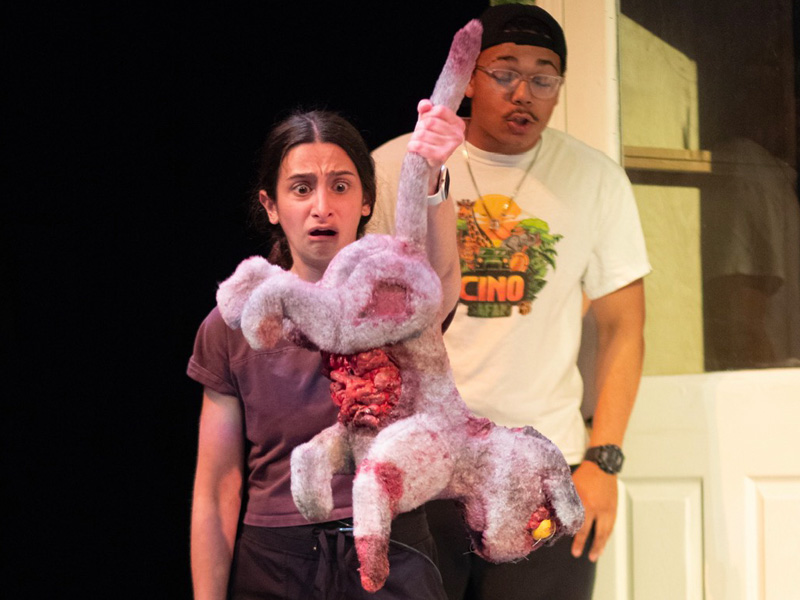
Eugéne Ionesco’s Rhinoceros may have premiered in 1959, but its warnings feel startingly current to a modern audience. Coastal Carolina University’s Department of Theatre presents the plays on select nights, April 17-26, in the Edwards Blackbox Theatre, inviting viewers into a world where ordinary people begin transforming into rhinoceroses. The plot follows Bérenger, and unremarkable everyman, as he watches his friends, coworkers, and neighbors abandon their humanity in favor of the herd. At its heart, the play asks a question that feels painfully relevant in 2026: What does it take to stay yourself when the world demands you become something else?
Director Matthew Schneck, assistant professor in the Department of Theatre, chose to produce Rhinocerosprecisely because of that question.
“It’s an anti-totalitarian play,” he said, “one that resists being pinned to any single ideology. Ionesco was adamant that it wasn’t just anti-fascist. It’s anti-anything that demands blind conformity.”
Schneck explained that he wanted to put the play on now because students are navigating a cultural moment defined by polarization, algorithmic pressure, and the constant demand to pick a side.
“They’re living in a world where identity, belief, and belonging are all under negotiation. This play gives them a way to talk about that,” Schneck added.
To ground those conversations, Schneck introduces audiences to absurdism, the theatrical movement that shaped Ionesco’s work. Absurdist theatre uses illogical events, exaggerated behavior, and surreal imagery to reveal the instability and contradictions of modern life.
“There is humor in everything, even the most serious stories,” Schneck said. “Absurdism lets us approach difficult topics from a different angle. You get pulled through the humor, and then the rug gets pulled out from under you.” For him, the absurd is not a gimmick, but a mirror. “The world of the play should feel normal. It’s the world itself, not the set, that becomes absurd,” he continued.
One of the actors stepping into that world is Lisbeth Montes Chacón, a senior B.F.A. musical theatre major who plays the Proprietor. For her, the play’s themes are not abstract. They are lived.
“As a Hispanic woman, I’ve often felt the weight of societal expectations,” she said. “Growing up, I sensed I needed to conform to appear less different. Women are expected to behave in certain ways, and being part of a minority group reveals how ingrained those expectations are.” In Rhinoceros, the transformation into these animals becomes a metaphor for the subtle, and sometimes violent, forces that push people to abandon their individuality.
The rehearsal process made those forces feel even more immediate. Early table work invited the cast to unpack the play’s questions together, exploring how fear, belonging, and identity shape the characters’ choices.
“Some people focused on how fear pushes others to conform,” Montes Chacón recalled. “Others thought certain characters only pretend to conform and have always secretly felt differently.” One line from the play stayed with her: Is it better to speak or to die? “It shows how often people silence themselves instead of expressing who they truly are,” she said.
Schneck intentionally avoided heavy-handed political imagery in his production of the play, trusting the audience to draw their own parallels.
“You don’t need Nazi symbols or political iconography,” he said. “Tell the story. Let the audience make their own connections.” And the audience will do just that, as the play’s themes echo loudly in the present.
Montes Chacón points to real-world examples that feel impossible to ignore.
“Look at what is happening in the United States. Minorities face discrimination and terror simply because systems like ICE were empowered to act without accountability. People think they are just doing their jobs, but they are conforming to harmful structures,” she said. For her, the play exposes how easily society accepts injustice when it becomes routine.
At the center of the chaos stands Bérenger, the reluctant holdout who refuses to transform. His final declaration, I am not capitulating, captures what Schneck calls a “reluctant hopefulness.” It’s not a triumphant ending, but a human one. Montes Chacón hopes students feel that, too.
“I hope they are inspired by Bérenger’s individual strength. I hope they feel confident in their interests and beliefs without fearing how others will react,” she continued.
In 2026, staying human means staying honest. Staying honest about who we are, what we value, and what we refuse to become. Rhinoceros reminds us that even when the world stampedes towards conformity, one person standing firm still matters.
Reece Neary (rmneary@coastal.edu) is a senior marine science major and English minor.