
CCU faculty and middle school students infuse science into creativity
Bordering the property of St. James Middle School awaited the wetlands and forest as hundreds of middle schoolers escaped the carpool line, grabbed their backpacks, and flocked into the building like a herd of buffalo. For a few hours that day, they would get the chance to release their natural energy by exploring a forest and channeling it into creativity.
Over the period of two days, a group of three CCU faculty, three CCU graduate students, four CCU undergraduate students, and four St. James Middle School teachers guided about 400 seventh graders as they pranced about the woods, traipsing through mud and splashing in puddles after having sat like a pack of sardines inside a classroom. Some shoes and socks might have been lost to the swamps, but the students experienced a form of learning in those two days that they’ll never forget.
Amber Bacon, lecturer in the Department of English, stood watching the group of students take part in a project she had begun planning a year earlier: a literary field guide blending students’ creative writing with scientific work on the local species. She wanted to show students, at precisely this age, that science and creative writing are not mutually exclusive, but complementary. Her idea became an accepted grant proposal with the Horry County Higher Education Commission, then a plan, and eventually, a hands-on classroom project.
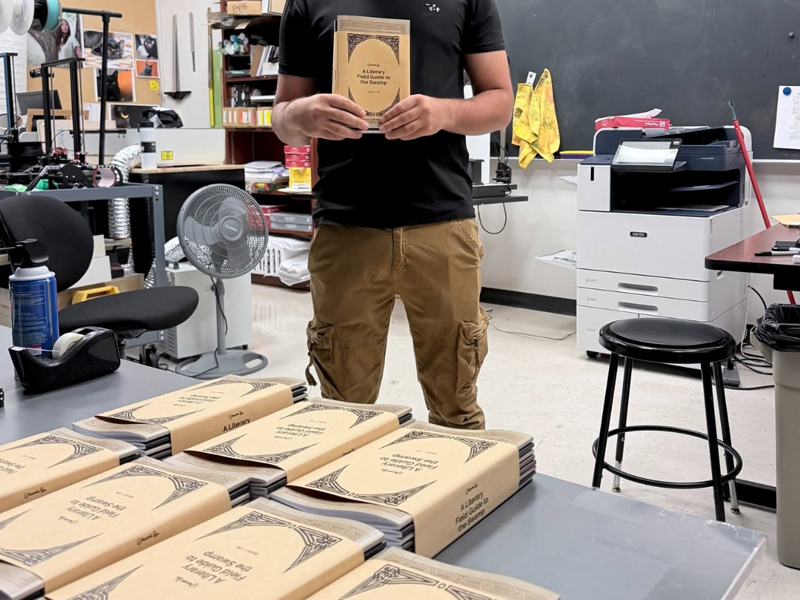
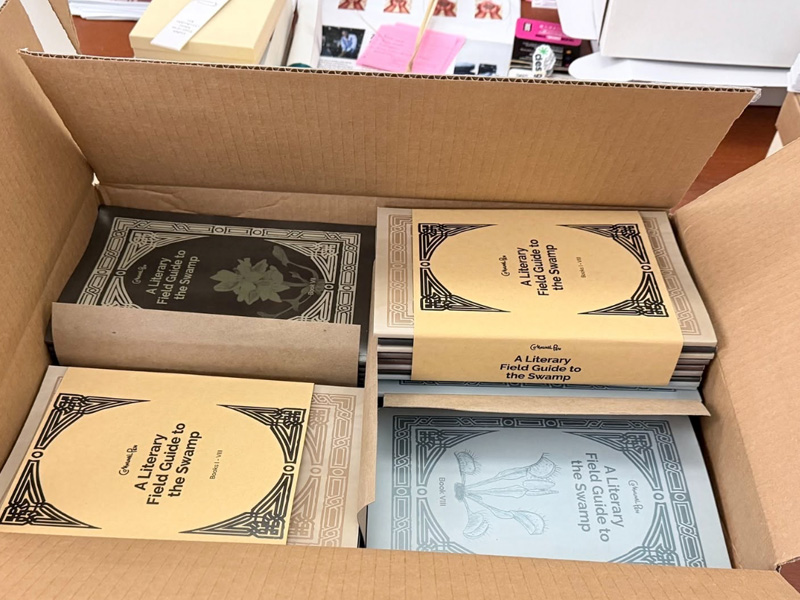
After the students explored the woods, they wrote creative pieces about their discoveries. Those written pieces were submitted to Bacon and then to The Athenaeum Press, a student-driven publishing lab in the Edwards College. Undergraduate and graduate students in The Athenaeum Press have transformed the students’ work into an 8-part book series titled A Literary Field Guide to the Swamp.
“It was really fascinating to see” the students’ reaction when they entered the woods, said Bacon. “Once they hit the forest … they kind of went wild.”
The project was the result of Bacon’s interest in interdisciplinary studies and her desire to prove to students that their work could be published and printed. Bacon had originally been inspired by numerous concepts, and one of them was her colleague Hastings Hensel, senior lecturer in the Department of English.
Hensel is an editor of the Winyah Bay Watershed Literary Field Guide, a collection of work by local authors. The book consists of nearly 40 total species, featuring for each a visual representation, scientific identification habitat behavior, and a poem about the species.
“In the introduction … we defined our local community as our watershed, meaning if the rain falls in your backyard and drains into the Winyah Bay, then you live here,” said Hensel.
Bacon had also been inspired by her teaching experience in a public Montessori School, where she first experienced interdisciplinary work in action.
According to the U.S. Department of Education’s Science Education through Creative Writing, A Case Study Using Entomology, by Lauren Osborn, Wyatt Hoback, Aimee Parkison and Doug Golick, topics like science and creative writing are typically introduced in school as two different disciplines. This leads to a false dichotomy of career paths and even self-identification. The study goes on to argue that interdisciplinary work between the topics helps students establish connections between the two, resulting in an increased interest in both required education courses and courses of interest. The Literary Field Guide to the Swamp shows students science and creative writing are mutually inspiring.
“It opens up a possibility that you didn’t know was an opportunity before. When I was a seventh grader, I had no idea writing could be a career. Maybe if I’d had experiences like this one, I wouldn’t have waited till I was 35 to start writing,” said Bacon.
Back beneath the trees on Bacon’s first day at the middle school, she watched students collect some of nature’s gifts: branches, leaves and flowers, while a few students even crouched down and collected mud from puddles. In addition to gathering resources, they made note of what they saw. The following day, the students wrote creative pieces based on the specific organism they were assigned.
A week later, Bacon sat at her computer as the students’ written work trickled into her inbox, each consisting of scientific facts of a local organism; a creative short story, poem, or narrative nonfiction piece; and an illustration.
“I think that getting them out of the classroom and into the forest was huge. The teachers said things like, ‘You don’t understand. You can’t tell because middle schoolers try to act so cool, but they will not forget this,’” said Bacon.
Billy Buckley, St. James Middle School science teacher, said the project not only fit perfectly within their curriculum, but also fully engaged and excited the students.
“Our students were so eager to work with CCU professors and students on this project. Much of our standards throughout the year connect to the importance of ecosystem health, biodiversity and the reliance humans have on various environments,” said Buckley. “We are so proud of the products they have submitted, and they can’t wait to see their work in a REAL book.”
At one point, amidst the chaos, three students had spent 15 minutes playing in the water with a strainer, after which, their teacher joked that they’d never seen those students spend so long focused on one activity. “It felt like they were in their native habitat, finally … I don’t think many of them had been in the forest for years,” said Bacon.
“It’s good for [middle school students] to realize there are people who are really interested in this kind of stuff – not just the science part, but the English and the education parts,”
Jacob McLamb, English Education major
Yet soon enough, Bacon, Hensel, and Erin Slaughter, assistant professor in the Department of English, found themselves at a loss with how to rein the kids back in, having been used to teaching college students. Luckily, the CCU education students that came along were able to put their experiences to the test.
Junior Jacob McLamb, English Education major, said that if someone had come to his middle school classroom and told him to go play in the woods for 30 minutes, he’d never forget it. Even now, in college, he said, the opportunity to participate in the project will stick with him forever.
According to Student Adventure’s Why Middle School is the Perfect Time for Experiential Learning, an experiential education helps support the transition in students’ understanding of what they are learning, specifically at the influential age of middle school. These experiences allow students to see what they are learning as tangible concepts rather than flat and distanced words on a textbook’s page.
Kylie Harris, student in the Master of Arts in Writing program, said she listened in awe as the students threw out their ideas for the creative pieces, some writing a day in the life of a mouse or even an alligator.
“I saw the same enthusiasm on day two, in the creative writing, as I did one day one, in going outside,” said Harris. “So that was really fun and interesting to see, something that you don’t always see on a college campus.”
McLamb believes The Literary Field Guide to the Swamp could yield a larger life lesson than just observing nature and writing about it.
“It’s good for [middle school students] to realize there are people who are really interested in this kind of stuff – not just the science part, but the English and the education parts,” said McLamb, and that they can make a career out of the blend. “We want to show them that the world doesn’t stop in seventh grade.”