
By Augustus Tuttle
The Edwards College is a vault of memory. If you were to walk its halls at this very moment, whether for the exercise or for the routine speed-walk of the academic, you would find yourself surrounded by treasures. Along the walls lie some of this vault’s gems. Posters that scream of life, coming in more colors than can be reasoned, dot everything. If you walk past the posters and can stamp off the cold of an unmerciful air conditioner, you will see paintings of such great size that you will have the impression of being looked down upon by some great council. If you keep walking past the crowd of people that press around you, their destination likely little different from yours, you will see the true treasure in the crossing.
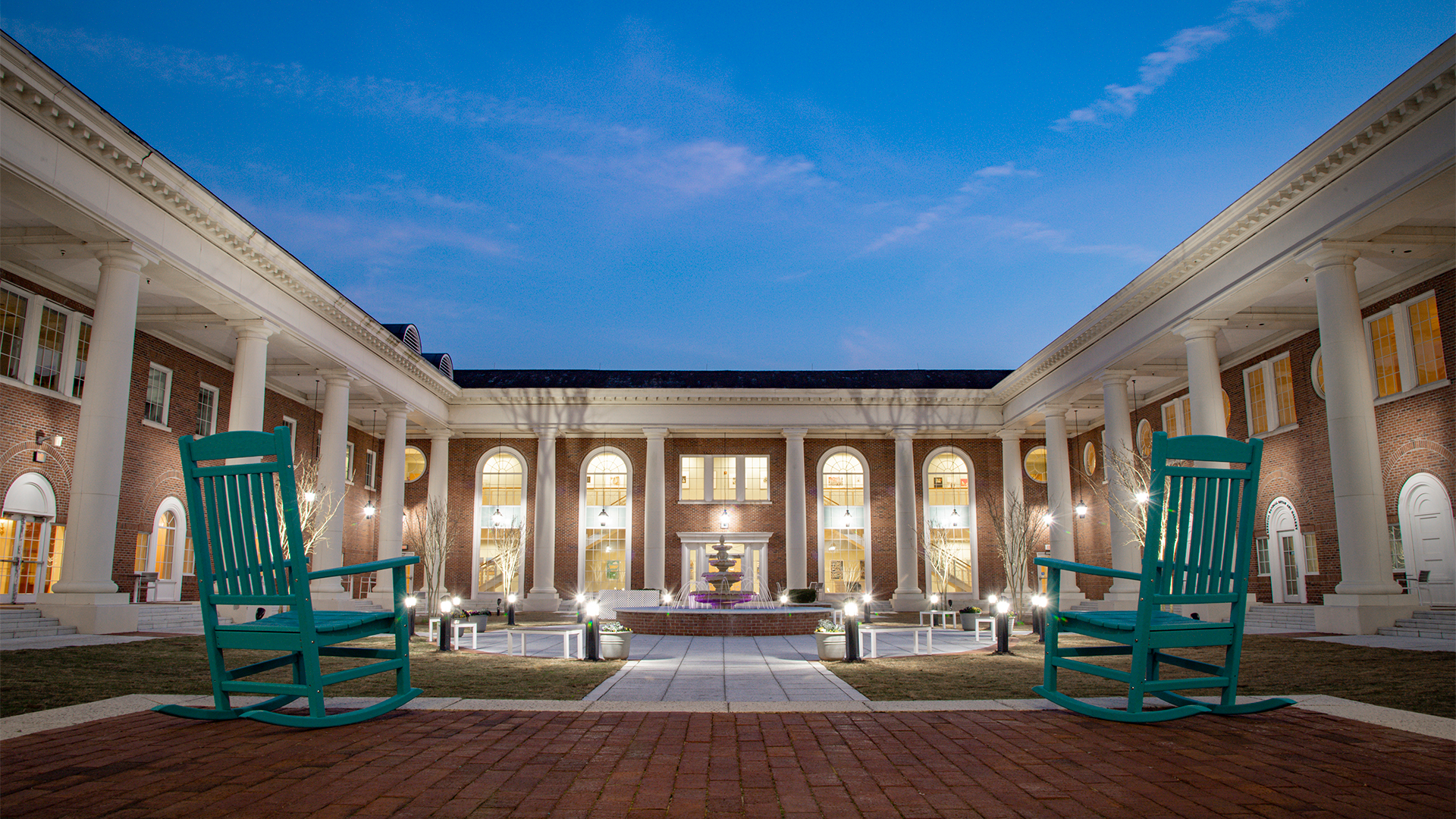
As you continue walking, you will come across sets of stairs. It does not matter which you decide to go up; the destination is the same. Once you are up and past the line of people walking down, you will look down past the windows and see a courtyard in the imitation style of the ancient Greeks and Romans. The whole scene will nearly blind you if the white columns and great fountain are caught in the sun.
Not far from where you stand, you might come across a professor named Dr. Kristen Fleckenstein. She is a linguistics professor in the Department of English and has been in the Edwards College for seven years. She recalls students joking about the raid on ‘Area 51’ during Covid that viewed the courtyard as a dangerous space with high potential for contagion, discusses the excitement her students feel when going to events that offer post-graduate directions, and conveys a desire to create more events that pull different studies together into a format that is “cultural, but educational.”
As you pass Dr. Fleckenstein and walk along the top floor, following the outline of a courtyard still visible from circular windows, you will find yourself facing a corner along the hallway. In that corner you will see three wooden benches, almost identical, each with an engraved bronze plaque. One belongs to Don Millus, an English professor who got his doctorate from Yale, loved fishing and wrote on the subject (alongside many other topics), and loved Coastal baseball with a passion. Next to Millus’ bench, there is Peter Lecouras’. Professor Lecouras went to USC for his master’s and was a prolific writer of English academic journals. The next bench over belongs to Thomas J. Trout. Trout was an English professor as well as a chair of the department. Each of these benches rest together, almost as friends taking a moment of respite and conversation with one another. Such a feeling is reified by the times I have spent on those benches, the times I, and maybe even you, have spent talking with friends or taking a moment of calm on those benches. The mightiest emperor could not leave so great a legacy as a moment for a friend.
As you walk past the monuments, you may very well come across an English faculty member racing to her next class. Emma Howes, associate professor, has been at Coastal for eleven years and focuses on composition and rhetoric as well as archival studies. Her fondest memories of the College stem from its events, whether it be the theatre productions or, beyond the walls of the College, onto Prince Lawn for live concerts. Among the events she loves the most is the former ‘Empty Bowls.’ This event featured ceramic bowls hand-crafted by students and faculty in the Edwards College studio, which were then sold and filled with homemade soup in the Edwards Courtyard. Proceeds from the event went to two local charities. If you do actually come across Howes on your travels and care to ask about her memories of those events, her ceramics collection garnered by the latter is sure to come up.
If you keep walking around the building and refrain from the ease of becoming totally lost, eventually you will stumble onto a room. Its floor is a lush, brownish-grey carpet, and at the center is a fine and glossy wooden table that bears a shape reminiscent of a raft. The table carries with it the impression of importance, as if at some point a document was signed on its surface that carried weight as sound carries across water. All around the table is a collection of red cushioned chairs with the same varnish as their center, the same impression of distant importance. If you were to approach and walk through the doorway, you would at once drink in the fine décor along the walls and a smell like the ocean in your memory. All around that room are plaques and posters in loving memory of the room’s namesake, Dr. Charles Joyner. Dr. Joyner’s work, most famously Down by the Riverside: A South Carolina Slave Community, is still used as a compass in Southern history and cultural studies. If you are, or are to be, a student of Southern history or Southern studies, you will hear his name often.
Possibly not far from the Joyner Room, you will find an anthropology student in his senior year by the name of Hunter Murray. He might be looking down at the Edwards courtyard where he once played his mandolin, or he might be walking to class. He might even be doing the same thing you’re doing. He recalls the joy of playing that mandolin, the newness of a freshman year graphic design course, and the anticipation for concerts and shows hosted by the College. Whether or not you choose to strike up a conversation with him, you will still find yourself passing through those coming and going in the same circle you are, and the whole lot headed to a thousand destinations.
On your way to wherever you are going, you will likely see another professor on her way to class or perhaps taking a moment for herself. Tabitha Lowery, assistant professor, has taught and researched African-American literature in the English Department at Edwards for six years. Lowery recalls fondly Humanities Week Research Symposiums and presenting her shared research with students, doing a class video call with award-winning author Tomi Adeyemi, and bringing conventionally sidelined works and authors to the attention of her students.
You walk away, now. Wherever you are going, you have circled through Edwards’ halls as so many others have and seen a fragment of what makes it unique. It is not just the paintings, posters, or air conditioning that makes Edwards what it is. It is the memories, the legacies, the people. When discussing her fondest memories of the college, Howes speaks of its people, calling them the “real strength of our college.” Lowery’s favorite moments are those that allow her to present “collaborative work with students and engage with faculty and student research and collaborations in the college.” Murray’s fondest memory is of spreading joy through his music. Dr. Fleckenstein articulates her own version Edwards legacy: “You are part of the legacy.”